
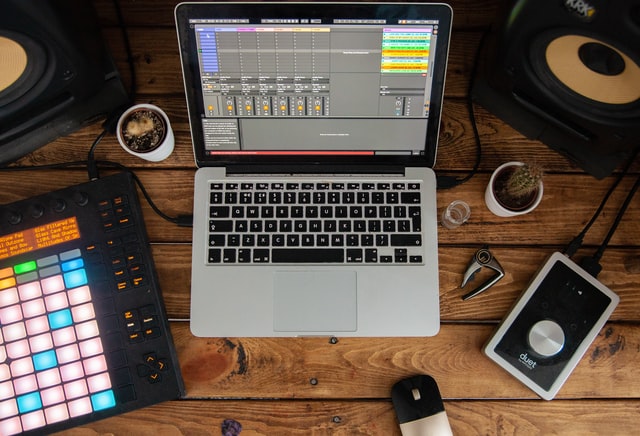
The KRK Rokit 6 is an ideal choice for listeners who are looking for a slightly bigger studio monitor than your usual 5″ models and comes with an affordable price tag. The larger woofer size also means it should have weightier low ends and can dig deeper into the bass extension. Still, the KRK Rokit 6 probably wouldn’t be able to reproduce subsonic bass frequencies prominently.
If you don’t listen to or work on bass-heavy soundtracks that consist of subterranean bass frequencies which go down to 20Hz or below then the Rokit 6 should be fine alone. For listeners who require such a level of bass performance, you probably would like to integrate an active subwoofer into your sound system. There are also other subwoofer requirements that you might want to consider as these will affect your choice of an active sub for your studio. Matching compatible subwoofer to your KRK Rokit 6 will also be as important.
Table of Contents
Sonic Characteristics of KRK Rokit 6 and Your Subwoofer Requirements
KRK Rokit 6 G3 cabinet design looks different when compared to the current generation of Rokit studio monitors. The front-firing bass ports of the Rokit 6 look slightly smaller as well but it doesn’t really matter since it could still dig down to 38Hz (-10dB). It could also reach up to 35kHz (-10dB) which is pretty impressive for a studio monitor at this price point. Having a front-firing bass port does allow us to place them nearer to walls. You might want to do some trial and error with the speaker positioning to find the optimal spot so as to provide you with a more balanced tonality and sound reproduction. Another way will be using the high and low-frequency adjustment setting to tailor the sound to your liking. We will suggest using both methods though.
The KRK Rokit 6 is bi-amped, it uses a Class AB amplifier with 48 Watts of power to drive the 6″ (150mm) Aramid Glass Composite woofer. It is not bad but won’t be enough to push out subsonic bass frequencies at a prominent volume level without sounding distorted. Even though we said that, when the music starts playing, the KRK Rokit 6 is capable of dishing out some serious bass performance, where you might think the Rokit 6 (G3) studio monitors might not need support from an active subwoofer.

More Details at Amazon – KRK ROKIT 6 G3 6″ Studio Monitor
There is warmth in its overall sound reproduction and is full-bodied as well. The punchy bass performance of the KRK Rokit 6 seems to have a higher output when compared to the current Rokit generation 4 studio monitors but it is not as tight. The overall bass performance may seem authoritative, but when it comes to the subsonic bass reproductions, you can tell it starts to roll off drastically. This is as expected from a studio monitor of this size and price. The treble is easy on the ears, the highs are extended and filled with details. Pushing the KRK Rokit 6 won’t make them sound harsh which is great if you need to use them for long hours.
As mentioned, the subterranean bass reproductions of 30Hz and below are simply lacking, if this is a requirement, you might want to consider a subwoofer that can deliver this level of low frequencies. To hit this subterranean bass level with prominence and produces them out with weight, such subwoofers won’t be cheap and you should work on your budget as well as check the available space you have in your room. Since more than likely, this type of sub is going to be quite large in size. Having more available space will be amazing too as you can do a subwoofer crawl to find the optimal position for your sub where it could perform at its best.
If you are sharing the subwoofer with your loved ones or colleagues, you should also ask them for their requirements. The clarity level of the KRK Rokit 6 is not that great and there are times the bass frequencies will muddle the mids. If this is a concern, you might want to go with a studio or sealed subwoofer for a more accurate and tighter bass delivery. These are just some of the usual subwoofer requirements and you should list out as much of them on your own as it will help with your decision. When you are ready, please take a look at the best subwoofers which you can go for and match them with your KRK Rokit 6 studio monitors.
KRK Rokit 6 Specifications
- Power Output: 73 Watts
- Drivers: 1″ (25mm) Soft Dome Tweeter, 6″ (150mm) Aramid Glass Composite Woofer
- Frequency Response: 38Hz-35kHz
- Max SPL: 107dB
- Dimensions (H x W x D): 332mm x 226mm x 290mm | 13.1″ x 8.9″ x 11.4″
- Weight: 8.4kg (18.5lbs)
Best Subwoofers to pair with KRK Rokit 6
SVS makes some of the best subwoofers in the world and at a modest price, the entry-level SVS SB-1000 Pro is certainly one of them. This is a 12″ sealed subwoofer which have undergone upgrades and now has better performance than its predecessor, much like the KRK Rokit 6 G3. With 325 Watts RMS power, the SB-1000 Pro is able to deliver powerful low-ends of down to 20Hz. The authoritative low-end performance of the SVS SB-1000 Pro is tight as well, giving us an accurate deep bass reproduction with articulation. This powered sealed sub will be an amazing match for the KRK Rokit 6.

More Info at Amazon – SVS SB-1000 Pro Subwoofer (Black Ash)
If you are not sure whether to go for a sealed or ported subwoofer version, the HSU Research VTF-2 MK5 will be an exceptional choice for you and your KRK Rokit 6 studio monitors. You can switch between two modes ported or sealed. The VTF-2 MK5 is a powerful 12″ hybrid subwoofer with up to 1400 Watts of peak power. In ported mode with 1 port open, this HSU Research sub can deliver subterranean bass frequencies of down to 16Hz which is really incredible for a modestly priced active subwoofer. When in sealed mode, the HSU Research VTF-2 MK5 can produce low frequencies of down to 22Hz bass extension.
Pairing the KRK Rokit 6 with a studio subwoofer made by the same company is an excellent idea and KRK S10.4 is one of the best choices to go for. As both of them would have similar sound signatures, they should work together harmoniously and deliver a powerful overall sound reproduction seamlessly. The KRK S10.4 has a 10″ glass aramid composite woofer been powered by 160 Watts of continuous power provided by its Class D amplifier. The KRK studio subwoofer is able to deliver a frequency response of 30Hz to 110Hz and would be good enough for most music genres.

More Details at Amazon – KRK S10.4 10″ Studio Subwoofer
The Yamaha HS8 Studio Subwoofer is another exemplary choice to go for and to partner up with the KRK Rokit 6. As it is an active subwoofer designed and made for professional use, we can be certain of its bass accuracy and speed. Sure enough, the HS8 Studio Subwoofer delivers powerful low frequencies cleanly and clearly with plenty of bass details. The articulate bass performance is fast and tight without trying to overwhelm the upper registers. For a modestly priced 8″ powered sub, the Yamaha HS8 Studio Subwoofer has a really impressive frequency range of 22Hz to 150Hz.

More Information at Amazon – Yamaha HS8 Studio Sub
This is another exceptional subwoofer with 2 unique operating modes, the SVS PB-1000 Pro is a 12″ ported subwoofer which will match well with the KRK Rokit 6 especially if you want higher bass output and a more thunderous low-end delivery. You can switch to “Sealed” mode for tighter bass performance and slightly faster speed. PB-1000 Pro is an entry-level subwoofer with plenty of muscles, has up to 820+ Watts of peak power, and can deliver down to 17Hz bass extension. This is also an ideal subwoofer choice for listeners who watch a lot of movies and action-packed TV shows using their sound system.

More Info at Amazon – SVS PB-1000 Pro Ported Sub (Black Ash)
For listeners who prefer to use a studio sub from the same brand but with a smaller footprint then the KRK S8.4 is a fine subwoofer partner for your KRK Rokit 6. The KRK S8.4 works well with smaller KRK studio monitors as well as small studios/listening rooms. It has an 8″ (200mm) glass aramid composite woofer powered by a 109 Watts Class D amplifier. This is an outstanding studio subwoofer for nearfield listening and with features such as the Bypass Footswitch, it makes audio mixing and mastering work more convenient. KRK S8.4 may be small and compact in size but it would be loud enough for a small listening room/studio.

More Details at Amazon – KRK S8.4 8″ Powered Studio Subwoofer
To Conclude
It is recommended to audition the subwoofers in your own studio if possible, as more than likely your room will be acoustically treated. What you hear in the showroom might be way different when compared to playing the subwoofers in your own treated studio room. You can also pair the shortlisted subs with your own already broken-in KRK Rokit 6 studio monitors during the subwoofer audition so as to get more accurate test results.

